
Less manual work
Agents run tool-driven checks and keep results alongside the task. Specialists spend less time switching utilities and copying output.
Calibri combines its own model, algorithms and tools to plan and test attack vectors. Run an automated penetration test or guide it with your team — from reconnaissance to evidence and reporting.
Agents run tool-driven checks and keep results alongside the task. Specialists spend less time switching utilities and copying output.

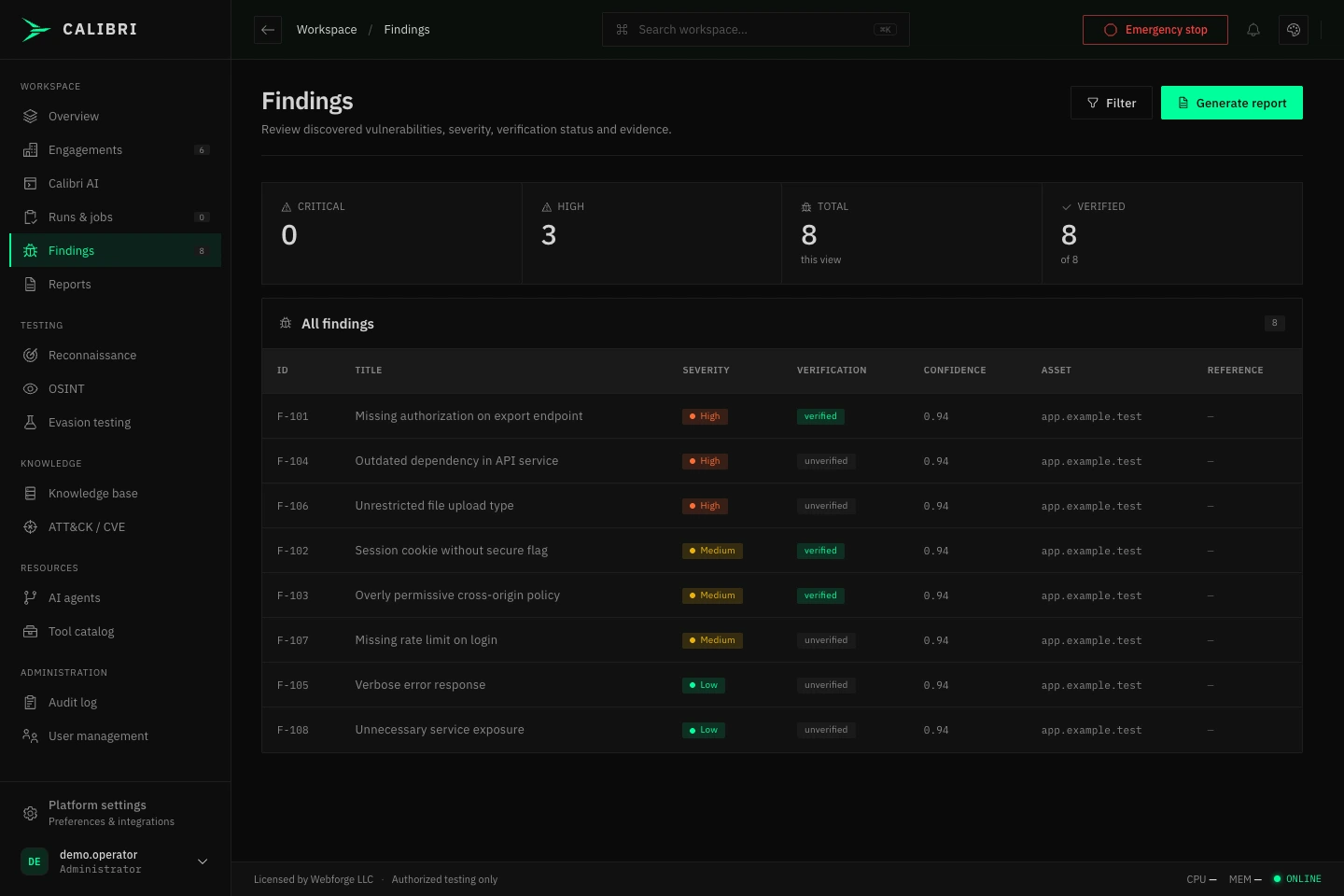
Findings include a description, severity, evidence and recommendations, helping developers understand the issue and start remediation.

Generate PDF, DOCX or HTML from collected results without rebuilding a document from scattered logs and notes.
Internal estimates from our own penetration tests. These are results for particular tasks, not a guarantee for every project. A pilot will measure the effect for your scope, including specialist review of findings.
Evaluate the impact for our teamWebforge’s model analyses target context, plans attack vectors and selects a sequence of available checks. Your team gets a workflow with tools and results, beyond advice in a chat.
Recon Framework feeds reconnaissance results into Calibri. Delegate an agreed scenario to agents or guide the test together: set direction, review results and refine the next step.
Calibri groups duplicate findings by vulnerability type and location, weighing evidence and counterevidence. Your team can focus on confirmed risks and see which findings need further investigation.
Define the target, scope and permitted actions. The model plans steps, runs available tools and uses results to guide further checks. Agent tasks operate within time and action limits.
See it in a demoReconnaissance, tool-driven checks, findings and reports in one catalogue. The figure counts platform functions, not installed utilities. Availability depends on mode, policies and workers.
Nmap, RustScan, Subfinder, Amass, HTTPx and WhatWeb: discovery of hosts, services and technologies.
Nuclei, Nikto, ffuf and SQLMap complement Calibri’s own JWT, GraphQL, CSRF and XXE checks.
SMBClient, SMBMap, LDAPSearch, NetExec, Impacket and BloodHound: analysis of services, access and relationships.
NVD/CVE, CISA KEV, SearchSploit, CVSS, OWASP and MITRE. REST API and MCP connect Calibri to external automation.

Assess an agreed environment before release and give developers findings with technical evidence, beyond a list of warnings.
Inventory exposed services, run selected checks and identify results that need system owners’ attention.
Keep the work and evidence in one workspace. Produce reports in the required format and show the client what was assessed.
Return to previous evidence and launch a new task on the changed system. Compare results with the original finding together with a specialist.
Increase assessment capacity and see which risks have evidence, who is reviewing them and what has been handed over for remediation.
Delegate repetitive operations to agents and keep client deliverables in one place.
Receive reproducible technical findings before release and after application changes.
Deploy Calibri in your infrastructure and connect workers to agreed targets. Use our pentesting model or configure a compatible provider: OpenAI, Claude, Gemini, Ollama or vLLM. During deployment we agree access, model context and CVE updates. Isolated environments require separate setup of local inference, update sources and outbound network restrictions.
Agree targets, access and permitted actions. Record the time your team currently spends on execution, review and reporting.
Deploy the platform, connect the model and workers, run the assessment and review findings with your specialists.
Compare staff effort, time to the final report and result quality for the same scope. Include manual finding review, infrastructure and model costs.
Need technical details?
Let's discuss your architecture and requirements.
They are Webforge’s internal estimates from its own penetration tests: Calibri accelerated checks and report preparation by up to 10 times and handled tasks that previously involved five specialists. This is neither a universal guarantee nor an independent benchmark. We evaluate your results in a pilot with comparable scope.
The platform takes on part of the tool-driven work and preparation of deliverables. Specialists define scenarios, assess the impact of actions, review findings and make final decisions. Their involvement is especially important for complex and unusual assessments.
A scanner searches for particular classes of issues. Calibri organises the assessment workflow: agent tasks, tools, assets, evidence, finding review and reports. It can fit a team that already uses testing tools.
No. The platform distinguishes confirmation from missing proof. Status, source evidence and confidence are available for review; a specialist makes the final assessment.
You can connect a cloud provider or a local OpenAI-compatible server. Execution quality depends on the model, tools and task. For isolated infrastructure, we separately agree compute resources and updates.
We start with a demonstration and an agreed pilot. Pricing depends on deployment, workers, models, usage and support. Tell us about your systems and current assessment process in your enquiry.
Before a run, we define scope, permitted actions, limits and a testing window. The platform checks policies, bounds execution and allows work to be stopped. These measures reduce risk but do not eliminate it; scenario impact is assessed together with the system owner.
These are registered functions an agent can use with tools, assessments, findings and reports. The normal mode exposes a subset of the full catalogue: some actions require additional configuration. We verify installed utilities, integrations and permissions for each deployment.
The project includes separate Android and Web3 analysis scenarios. Android requires the appropriate utilities, plus a device or emulator for dynamic checks. Web3 requires contract-analysis tools and RPC access. We verify the requested scenario and component readiness separately during a demonstration.
Our own pentesting model, Recon Framework, built-in attack checks, test request selection, finding consolidation and evidence assessment. They work alongside third-party utilities and established methodologies. Reconnaissance modules must be deployed; external sources require the relevant keys and network access.
See the path from an agent task to an evidenced finding and a finished report. For a pilot, we select an authorised target and compare the effort with your current process.