
Protect customer data
Substitute detected personal data before supported API requests reach an external model. Detected keys, tokens and passwords are removed without restoration.
Condr protects data in connected AI requests, checks code changes and shows AI spending by team. Deploy it on your own infrastructure.
Substitute detected personal data before supported API requests reach an external model. Detected keys, tokens and passwords are removed without restoration.

See which teams and models drive your bill. Set budgets, alerts and limits, and issue internal keys for the tasks each team needs to perform.

Go from an event to its triggered rule, check log integrity and export a period report. Give security teams material for investigation and assessment.
Condr recognises Uzbekistan's payment and personal data formats: card numbers, PINFL personal IDs, phone numbers, passports and full names in Cyrillic and Latin scripts. We test recognition on your examples during the pilot.
Condr’s own detectors run on your infrastructure without an external detection service. In supported API flows, personal data is substituted and secrets are removed before the request reaches the model.
AI request and Git change checks share the same detectors. A secret in a request, a suspicious dependency and an exception request are visible in one workspace.
Condr substitutes detected personal data before forwarding a supported API request and restores it in supported responses, including streams. Keys, tokens and passwords are removed without restoration. Supported AI agent tool results are checked too, including text from files and logs.
See it in a demo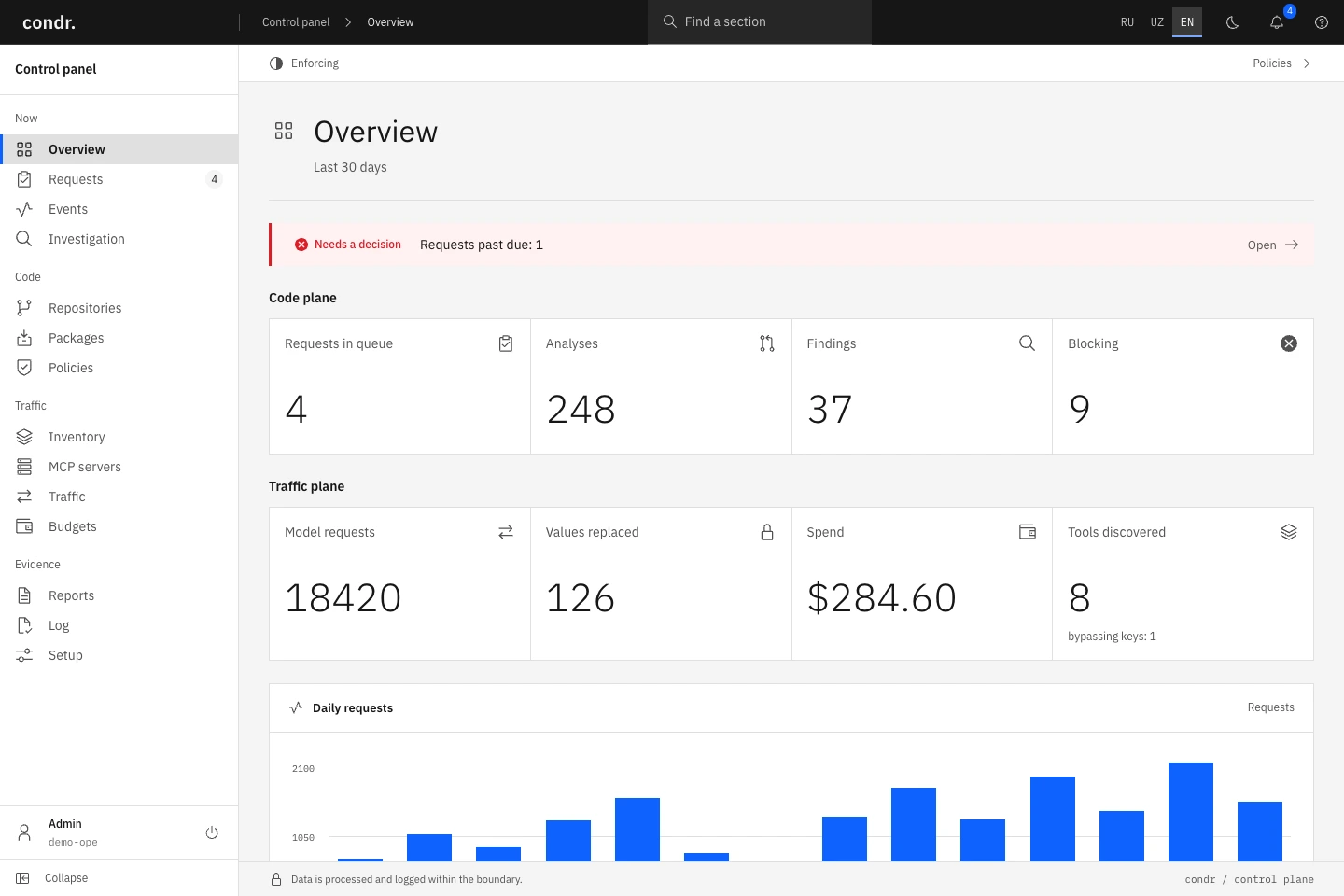

A developer sends a log to AI to investigate an error. In a supported API flow, Condr substitutes detected personal data and removes secrets. Substituted personal data is restored in supported responses, while security staff can review the processing event.
A dependency appears in a pull request. Condr checks package existence and provenance, adds findings and applies policy. The team can approve an exception through the shared workflow.
Spending is spread across models and departments. Condr consolidates tracking in one dashboard: see team consumption, set budgets and manage access through internal keys.
See which data was detected in connected traffic, which rule triggered and what to include in an internal control report.
Approve AI tools, review code and manage exceptions while preserving the team's workflow.
See which teams and models drive costs, where to set limits and which access to disable.
Condr is installed on company infrastructure. Requests from connected clients pass through its gateway; code changes arrive through Git integrations. Recognition runs locally. External model access requires permitted network connectivity. Before the pilot, we agree on routing, supported clients and limitations for web chats and attachments.
Agree on clients, models, repositories and connection architecture. Determine where substitution is supported, where detection and blocking apply, and which scenarios remain outside coverage.
Validate data handling on agreed examples and collect spending data. Start web chats in monitoring mode and evaluate dependency policies against past pull requests.
Review findings, recognition quality, costs and the report. Agree on exceptions and enable selected rules at your discretion. Pilot scope and timing are fixed before launch.
Need technical details?
Let's discuss your architecture and requirements.
Compare three needs: recognition of Uzbekistan-specific data formats, reversible personal-data substitution in supported AI APIs and code-change checks. Condr brings them together in one dashboard with shared detectors and auditing. A demo will show how it can complement your existing security tools.
We begin by reviewing your clients and connection model. Supported requests are routed through the Condr gateway. Configuration effort depends on the API, client and network mode; compatibility is agreed before the pilot.
No. Reversible substitution is designed for supported API flows. Connected web chats support policy-based detection and blocking without changing the request body. Attachments and traffic outside the connected environment have separate limitations. We will document coverage for your scenarios during the pilot.
Connected web chats can start in monitoring mode. Dependency policies can be evaluated against past pull requests so you can discuss potential restrictions with developers. API request handling, access restrictions and budgets are agreed separately before activation.
The demo covers a test request, the triggered rule, an audit record and spending tracking. For the pilot, we agree measurable criteria: visible traffic flows, recognised data, detections requiring refinement and actions the selected rules would have blocked. You receive a report for the agreed assessment scope.
The agreed delivery scope, deployment architecture and support requirements. Tell us about your AI tools and challenge in the request; after discussing requirements, we will prepare a proposal and pilot terms.
The report provides technical evidence for assessment. It does not replace an audit or certification. Reversible substitution also does not make data irreversibly anonymous.
See request processing, a policy match and team spending. We will discuss how to connect your AI tools.