

Less manual log reconciliation
Search user activity in a common event structure across Oracle, SQL Server and PostgreSQL. Follow an alert to its related events.
Peckr brings Oracle, SQL Server and PostgreSQL audit events together. Detect suspicious activity, investigate data access and send alerts to your SOC.
Search user activity in a common event structure across Oracle, SQL Server and PostgreSQL. Follow an alert to its related events.

Account for service accounts and sensitive tables. Test new rules against historical events before enabling them.

Track event flow, source health and channel errors. Receive alerts when monitoring may have stopped.
Replay a condition against recent events. Peckr shows matches and examples without creating operational alerts.
Compare operation counts with an account’s usual activity. Each alert shows the observed volume, baseline and amount of deviation.
View silent sources, agent health, queues and delivery errors in the console. Your team can investigate where visibility was interrupted.
Collect supported Oracle, SQL Server and PostgreSQL events. Search by database, user and action; available fields depend on audit settings.
See it in a demo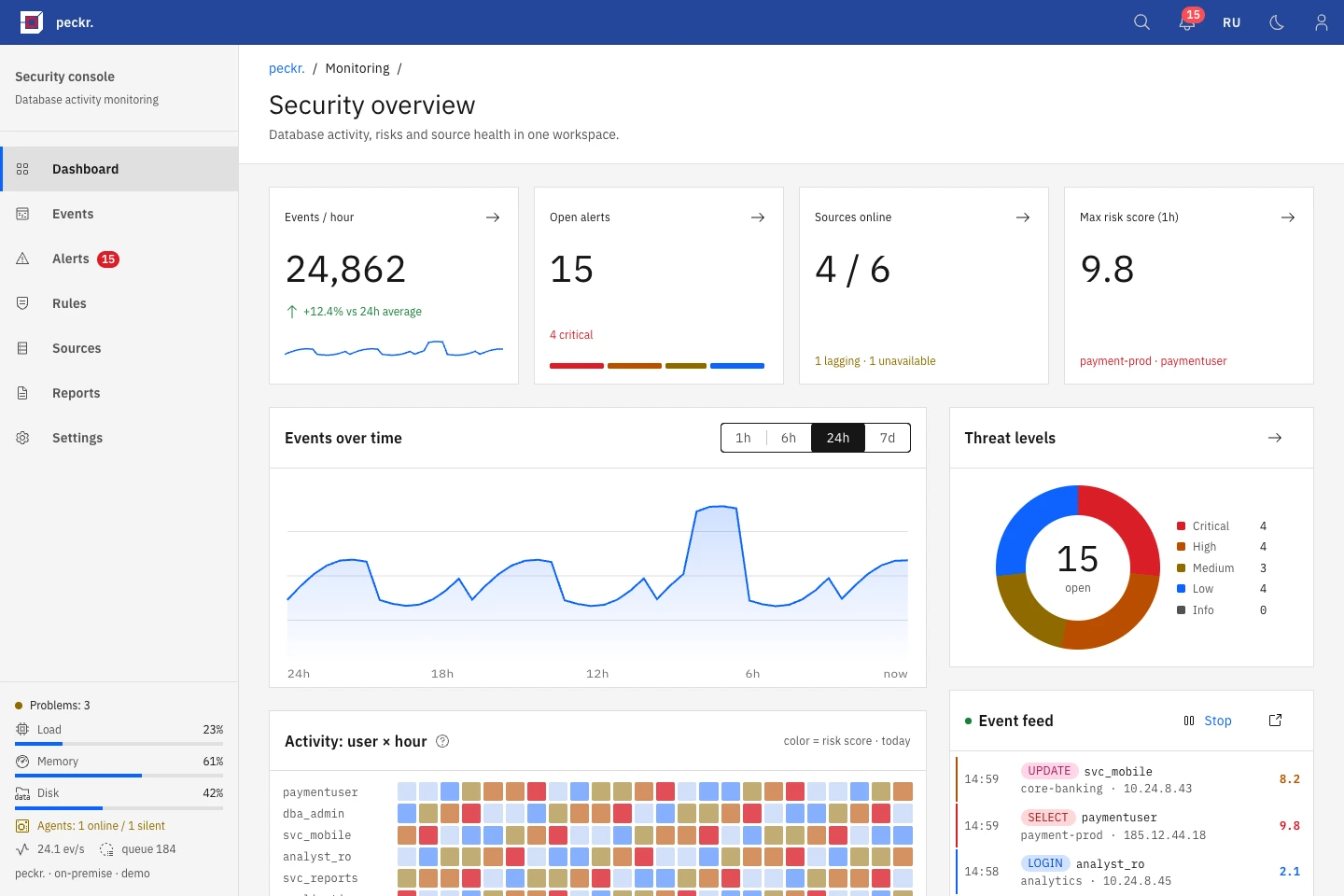

Mark important tables and investigate account activity. Retain related events, analyst conclusions and a report for the selected period.
Receive signals about suspicious changes. Enable Oracle and PostgreSQL snapshots to compare available security settings.
Test your rule on historical events, review matching examples and refine its conditions. Enable it for the agreed sources.
Identify actions requiring investigation, their sources and how to send alerts into your existing response workflow.
Check whether database audit data is arriving, which components are running and where event delivery has broken down.
Collect events, privileged actions and source data completeness for a selected period.
Deployed in your infrastructure. For each database, we agree on audit settings, permissions, the agent or collector, and delivery method. Peckr analyses incoming events without proxying user SQL queries. Monitoring coverage depends on collection settings.
Agree on the database system, audit scope, collector permissions and delivery method. Define a test event and expected result.
Connect the source, assess field completeness and test agreed rules. Label sensitive objects and review detections.
Check an alert in your channel, source health and a period export. Use the results to decide whether to expand the pilot.
Need technical details?
Let's discuss your architecture and requirements.
Peckr normalises audit events from different databases, adds source and rule context, and supports investigation. Alerts go to your SIEM for the existing response workflow.
Oracle: Unified Audit through a collector or file audit through an agent. PostgreSQL: supported logs through an agent or Vector. SQL Server: SQL Server Audit events from Windows Event Log through a forwarder. We verify settings and field coverage during onboarding.
The platform compares hourly operation counts with an account’s historical profile. After a learning period, alerts show the size of a deviation. This complements rules and still requires analyst judgement.
Yes. Replay events from the past hour, day or seven days without operational alerts. Up to 50,000 recent events are checked; the interface indicates when the selection is capped.
No. The platform passively analyses audit events. Your team or a connected system decides how to respond. We assess collection methods and database load during deployment.
We follow an action on a sensitive table through detection, analyst review, alert delivery and reporting. For your database, we agree on the source, audit settings and validation criteria.
Review a database event, the rule it triggered and a report. Choose a data source and agree on evaluation conditions in your infrastructure.